Who are we choosing to be?
The wave of trans exclusion that has swept across the charity sector during the first week of the festive season, just as the christmas lights went up and the full range of whacky flavoured hot drinks became available, has been – well - chilling.
First and foremost because of the very real impact this has on the safety, dignity and belonging of trans, non-binary and gender-expansive people.
I have witnessed my trans and non-binary friends struggle with their mental and spiritual health since the Supreme Court ruling in spring this year, I have read letters by trans people in my local newspaper describing their fear of walking around our north London neighbourhood, and I have heard accounts of trans people who were openly harassed in public spaces in a way they had never experienced before.
Now the charity sector is following suit, with Girlguiding and the Women’s Institute emerging as the most prominent organisations now openly barring trans people from their membership.
The exclusion of a tiny minority of the population - who place no threat to anyone whatsoever but whose existence and visibility threatens the ever-so-fragile gender binary created by patriarchy - is not the move of a progressive sector guided by care and compassion.
If you’re looking for facts and arguments, here are some:
The Not In Our Name (NION) Women campaign cites that 98% of sexual offenses are perpetrated by men, or, simply put, “trans+ people are not the cause of harm to women.”
Barrister Robin Moira White has been providing clarity about the (un)lawfulness of organisations implementing such policies, stating that since the Supreme Court ruling, “the U.K. is no longer compliant with the European Convention on Human Rights”.
TransLucent recently investigated the number of complaints received by local authorities about trans women using public toilets and found only TWO in a two-year period between 2022-2024, proving the alleged ‘threat’ of trans women using public facilities is virtually non-existent.
I could go on. But the question I’ve been asking myself and other cis women - especially QUEER cis women, and also WHITE cis women with FINANCIAL PRIVILEGE - is this: who are we choosing to be in this moment?
Are we going to be the ones who seek to grow our piece of the pie by throwing those more vulnerable than us under the bus, now that we have fought for at least some wiggle room from under the thumb of patriarchy?
Are we going to be the ones policing each other at the delight of the tech bros in power who love to watch us destroy our bonds of solidarity and then buy their consumer products in a desperate attempt to soothe our wounds?
Are we going to lean in and punch down in an effort to kid ourselves into believing that we will be ‘safer’ as a result, even though we know deep down that conditional safety means they will eventually come for us, too?
Or - will we take a deep breath, extend our arms and remember Auntie Lorde who taught us so many years ago that “I am not free while any woman is unfree, even when her shackles are very different from my own”?
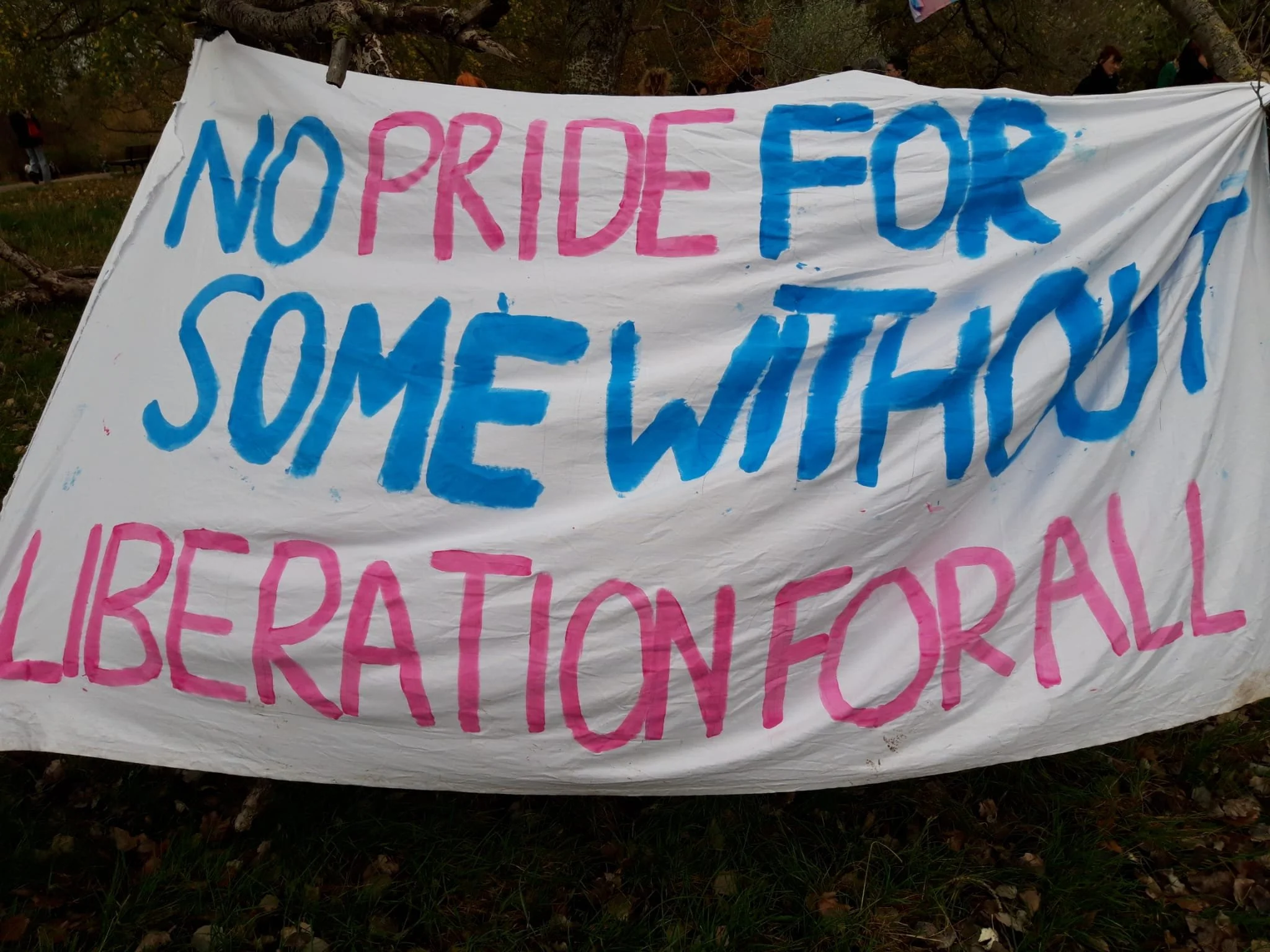
Photograph of a white banner tied in front of a tree, which reads in blue and pink letters ‘no pride for some without liberation for all’
We are the ones laying the cultural cornerstones for our daughters, niblings, elders and neighbours. Each of us gets to shape how big our tent of solidarity, community and mutual protection can be.
Our hands are not tied.
Yes, there may be disproportionate rage directed at Girlguiding and the Women’s Institute when the true harassers are anti-trans campaigners bankrolled by big money – it’s important to identify the source of the threat correctly.
But every one of us, whether as an individual, a leader or an organisation, has agency and can make at least some choices about how we respond to this moment.
Silence in the face of oppression and harm is complicity. Inaction is a kind of quiet enabling.
Not everyone has the same access, time, spoons, resources or safety net to participate. Tiny acts of resistance all count – together they will shape the tide.
One of the most powerful things we can do is to have conversations with people we already know but who may not be as clear and informed as we are. Calling in organisations is important, but as Mariame Kaba points out, true accountability can only happen in relationship, between people who actually know each other.
We are much more likely to change our minds if we are hearing a different perspective from someone we know and respect.
So, the next time someone tries to both-side an argument about trans exclusion, don’t skip over it. Maybe you’re the person doing that in the comments in some place on the internet. Sometimes that can be powerful, and leaving a record is important.
But crucially, talk with the women in your life who trust you and remind them that they have an opportunity to choose who they want to be in the face of this hatred.
A few other things you can do:
Sign the Not In Our Name open letter by women in support of the trans+ community
If you work in the charity sector, join the Third Sector Against Transphobia (TSAT) initiative to channel rage, grief and heartbreak into collective action
Donate to campaign groups such as TransLucent, who are building a counter-case to the legal challenge the exclude trans women from swimming at the Kenwood Ladies Pond, or charities such as Gendered Intelligence and Mermaids who support trans, non-binary and gender-diverse children, young people and their families
This moment calls for us to turn towards each other with love, not away from each other with suspicion.