Turning towards each other when things get hard
I know so many people (including myself) whose instinct in times of struggle is to withdraw. That can be very supportive if it gives you the space to feel your feels and to clarify your thoughts.
However, many of the things we are struggling with are structural in origin and therefore collective in nature. There is no individual healing from collective pain, even more so when that pain is on-going.
Many of us have been conditioned to only show up in social situations (bar with our closest people) when we are able to perform some kind of coherent and stable self. Otherwise, we are at risk of being ‘unprofessional’, ‘intense’ or ‘too much’. So, we hide to deal with ourselves and only go back out when we’re ‘better’.
Our culture certainly reinforces this move and punishes those lower on the socially constructed ‘ladder of humanity’ harsher for transgressing this norm, labelling them anything from ‘aggressive’ to ‘difficult’ or ‘hysterical’. This is designed to keep us separate and in line with the dominant systems of power.
But one of the features of trauma is not having a witness. Keeping our struggles to ourselves (or taking them out on someone else, which is another form of unprocessed pain), thinking we are the only ones unable to ‘get our act together’, only reinforces our isolation, shame and separation.
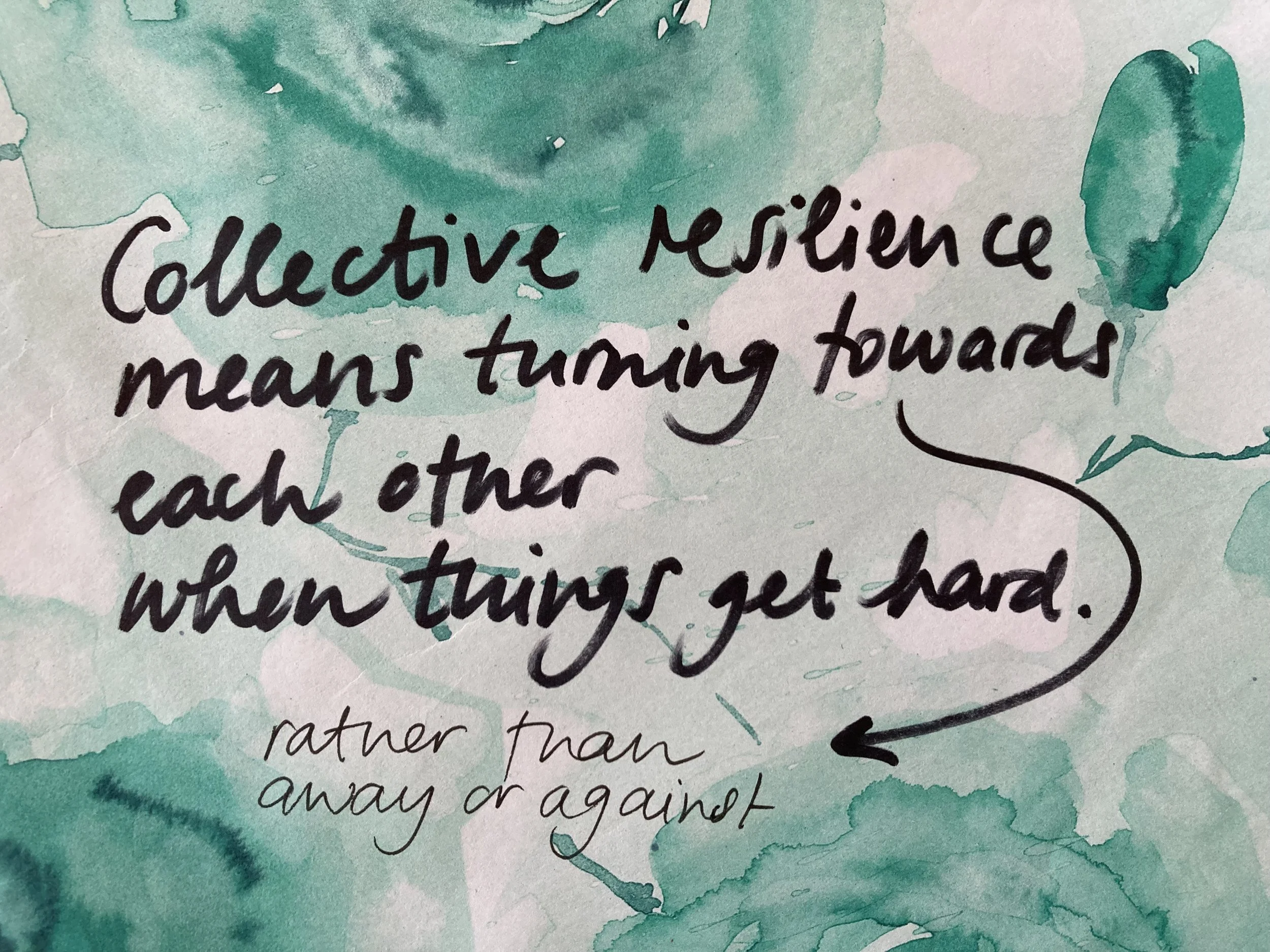
The sentence ‘Collective resilience means turning towards (rather than away or against) each other when things get hard’ is handwritten in black font on a white piece of paper with shapes in turquoise watercolour.
“We’re all better than we seem and hurting more than we show”, the brilliant Sarah Kendzior wrote on her Substack back in February. I don’t think that has changed in any significant way since then - in fact, it has likely gotten worse with authoritarianism, anti-immigrant racism, intensifying genocides, the erosion of truth and many other threats on the rise.
We cannot afford to remain isolated in a time when institutions that are supposed to protect and support systematically fail, harm and prosecute so many of us.
Remaining connected under pressure, conflict and internal differences isn’t easy. Anybody socialised in a white supremacist culture has learnt, at an embodied level, to “equate discomfort with danger”, as Christian Ortiz put it so succinctly. “But that is not truth”, Ortiz goes on to say, “That is conditioning.”
Turning towards each other, even and especially when we’re under pressure, is something we can learn. We can, in fact, grow more safety and spaciousness inside of ourselves so that we can make different choices than the social scripts we have been taught.
We can learn to distinguish, in our bodies, what is of this moment, right now, and what is of the past or of the future. We can learn to recognise when we’re reacting rather than moving from a place of intention and create more space both for our own feelings and those of other people.
I believe this is essential work during times of domination, deep uncertainty and eventual collapse. How can we remain in tact inside of ourselves and in our relationships so we can pick up the pieces, together?
It starts in our own bodies, but it is inherently collective. People engaging in this work inside of themselves makes any group, team, organisation, movement, family, community, society we are part of more resilient.