Finding “hope with an attitude”
Since the start of the year, myself and a (figurative) grey cloud of despair have been playing a game of cat and mouse.
It goes something like this: feel it hovering over me, moving closer and threatening to engulf me completely. I try all kinds of things to maintain some distance between us - art, sleep, exercise, nature, cold water swimming, embodiment practices, connecting with friends, lighting candles, planting flowers, singing, praying, reading, pouring myself into things that serve the collective.
They work for a while, and there are blips when I could even see glimpses of blue sky (literally, if you’ve been in London the past few weeks). But then it catches up again, reminding me that what I’m feeling and dreading sits somewhere stubbornly deeper.
I sometimes have a hard time with teachings about presence or consciousness, which remind us that most of human suffering is our ego telling a story, and underneath the story, peace, ease and joy are available.
I do believe this to be fundamentally true, but the way this gets presented sometimes can feel like it is minimising or trying to downplay or de-politicise what is happening in the world.
Despair, defeat and depression are all understandable responses to what is unfolding around us.
So when I heard Rebecca Solnit talk in a recent interview about why she feels hopeful right now, the grounded way in which she talked about hope struck a nerve.
“I totally understand and share some of the feeling of horror that people have in this moment”, she says. “But I think the big story [...] the right is telling us, if we listen carefully enough, is: you all are very powerful. You have changed the world profoundly. All this stuff you have done, whether it’s marriage equality or women’s rights or environmental protection or telling the real history of this country [US] are all connected. We hate it. We want to reverse it.”
Reflecting on the change she has witnessed over the past six decades of her own life, Solnit notes that “everything has changed, and it's changed in complex, subtle, slow, incremental ways that so often haven't been recognised.”
That was lesson number one - appreciating just how profound some of the transformations that have made it possible for me to sit here and write this post have been. (My grey cloud took a significant swoop to the side as this sank in.)
In the interview, Solnit goes on to talk about the fact that, in moments of crisis, the image of ourselves as essentially selfish beings gets disrupted. More often than not, what's revealed instead is a much more beautiful, relational, collaborative form of humanity (something Solnit explored at length in her 2009 book A Paradise Built In Hell).
"We are not who we're told we are", she says. "It is useful for consumerism, capitalism, authoritarianism, elites to say that ordinary people are selfish, greedy and cowardly.”
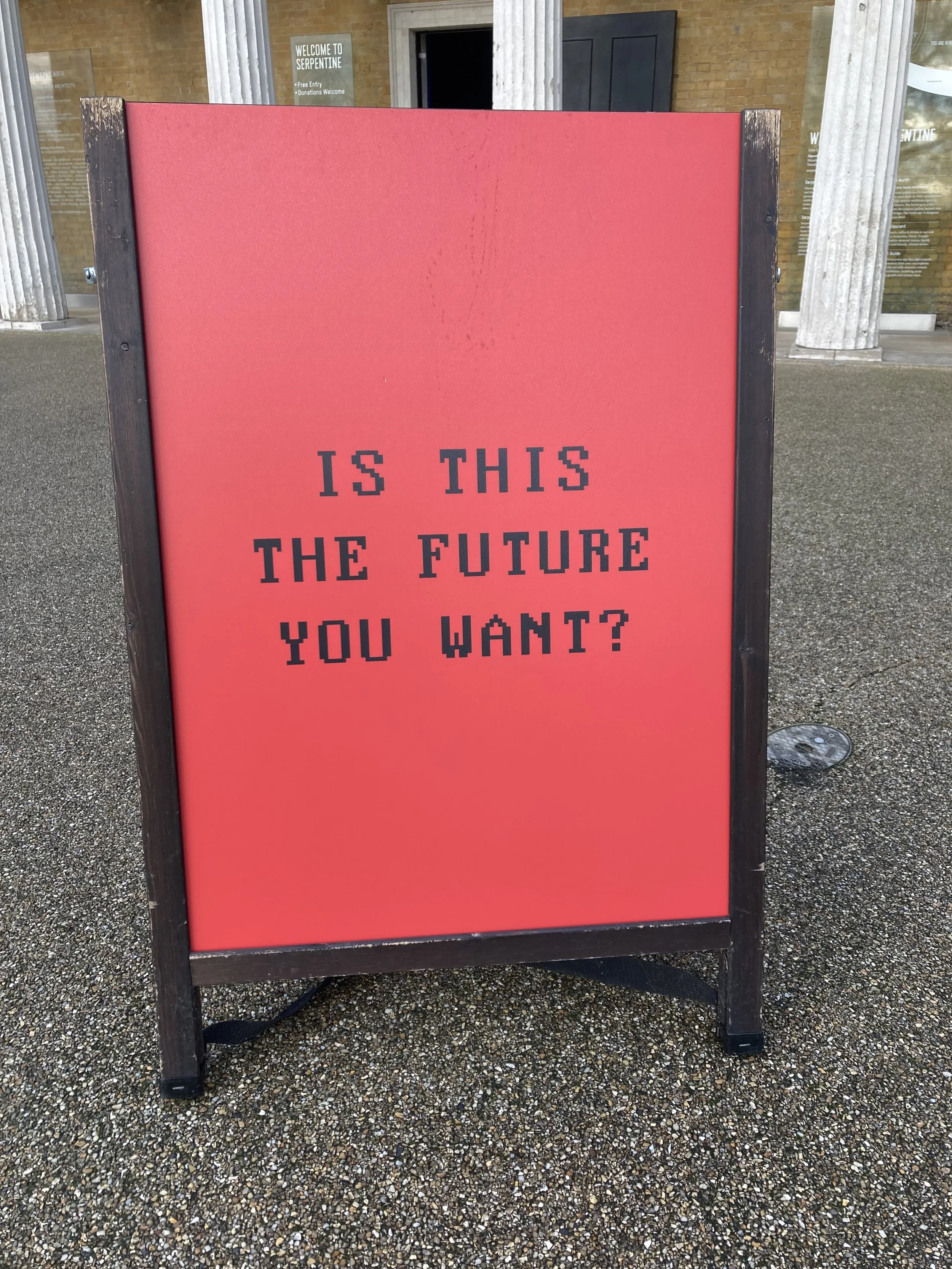
Photo of a red sandwich board with the letters “IS THIS THE FUTURE YOU WANT?” written in black ink. The board is propped up on a gravel floor in front of the Serpentine Gallery in London and was part of Danielle Brathwaite-Shirley’s recent exhibition, The Delusion.
There comes lesson number two - that if we act as if that selfish notion is true (by believing, for example, that nobody cares or has our back), we are playing directly into the hands of people who want to control, contain and exploit us. It’s a kind of ‘complying in advance’ with a world that doesn’t serve us.
This shows up in defeatist or fatalistic predictions about the future, even though the future is determined by how we are showing up here, right now, in the present.
“It’s this bizarre way people allocate themselves a power they don’t have to know the future, to abandon the power they do have, which is also a responsibility to make the future. [...] They’d love us to say we have no power and they won and we’re giving up. Why the hell would I ever give them the satisfaction?”
Lesson number three - the future isn’t inevitable. People have shaped history in really profound ways, which often weren’t big and loud but incremental and quiet.
Our hope doesn’t have to be some sort of overly ambitious, lofty vision that feels completely out of reach, It can be pragmatic, defiant, even a kind of punk rock “hope with an attitude” (or literally hopepunk).
(At this point, my grey cloud of despair felt the heat coming its way and moved firmly into the corner.)
“In some ways, everyday life under capitalism produces a lot of anomie and isolation”, admits Solnit, “a kind of lack of agency, connection, meaning.” So what are the antidotes to this despair?
Here are some ideas:
Staying connected to real people - in physical spaces and/or online, even (and especially) when there isn’t complete alignment
Giving and receiving generosity and care in defiance of the hostility around us - as Octavia E. Butler told us in the Parables, “kindness eases change”
Taking action, however small, with other people to shape the future - here’s a beautiful video of disabled activist Bethany Stevens talking about the different ways that can look
Finding pockets of joy beyond consumption - turning your face towards the sun as the days get longer, praying with others during the holy month of Ramadan, sharing a meal to celebrate the Chinese new Year of the Fire Horse, singing to yourself in the street…
Staying as far away from AI as possible - to preserve your humanity and to avoid replicating its colonial patterns
2026 so far has felt profoundly disturbing, disorienting and unstable (how very Aquarian). But instability in itself is neither good nor bad. In fact, it can be the precursor to deep change and innovation.
May we find hope in the agency we do have that is shaping our collective future every minute of the present.