
Team resilience
“We have to get really quiet and listen… we can’t use the same models of progress and push and control and force things to happen. We’re really being asked to approach [things] very, very differently.”
- Francis Weller
What is embodied resilience for teams?
Embodied resilience for teams is a 12-week online training and practice programme for teams who want to develop their capacity to navigate change, challenges and uncertainty with clarity, courage and care.
The programme teaches participants the theory and practices of embodied resilience, a highly effective, trauma-informed approach to real-time stress navigation that enables you to navigate life’s difficulties with more stability and choice without burning out.
In this video, I talk about why developing emotional and relational skills is so important for teams to be able to navigate the challenges ahead of them without people turning against each other or themselves.
You can read a transcript of the video here.
Why embodiment?
Our bodies are microcosms of the whole world. They hold vital information about us and our environments that we can learn to tap into.
In the dominant culture, cognitive skills are seen as superior to embodied knowledge.
Embodiment is an antidote to dehumanisation, division and disconnection.
Our bodies are not only a powerful tool but a doorway to ourselves, to each other, to our imagination and our shared humanity.
Why resilience?
Resilience is often understood in individualistic terms as the capacity to endure and bounce back from ever more difficult conditions.
This ignores the systems, relationships and wider conditions that shape our lives, stress and trauma.
Embodied resilience reframes resilience as inherently collective.
It sees resilience not as bouncing back from injustice and dehumanisation, but bouncing forward together to create a world that includes all of us.

What are the benefits?
Embodied resilience unlocks benefits both at individual and collective levels. At an individual level, it supports people to:
Notice their stress activation in real time
De-escalate their stress response if it is safe to do so
Change stress responses that are too strong, last too long or are no longer helpful
This brings more stability, balance and coherence into the nervous system, which enables more presence and helps prevent chronic stress and burnout.
At a collective level, embodied resilience expands people’s capacity to:
Notice their own boundaries and limitations before they have been crossed, which prevents burnout and enables sustainable working
Increase trust and safety across a team, which prevents fragmentation
Grow their ability to communicate with more emotional clarity and presence, which prevents misunderstandings and conflict
Increase their ability to receive critical feedback without getting panicked or defensive, which builds integrity and leadership
Learn to recognise other people’s stress responses and how to offer them support in moments of stress activation, which enables mutual care
Learn to navigate tension and conflict in ways that preserve rather than rupture relationships, which strengthens team cultures and prevents staff turnover
Access more creativity, ideas and imagination, which unlocks new strategic possibilities for the work of the organisation
Over time and through regular practice, people not only build more stability inside of their own nervous systems. They also expand their collective capacity to hold difference, change, complexity, uncertainty and conflict as well as connection, imagination, joy and creativity.
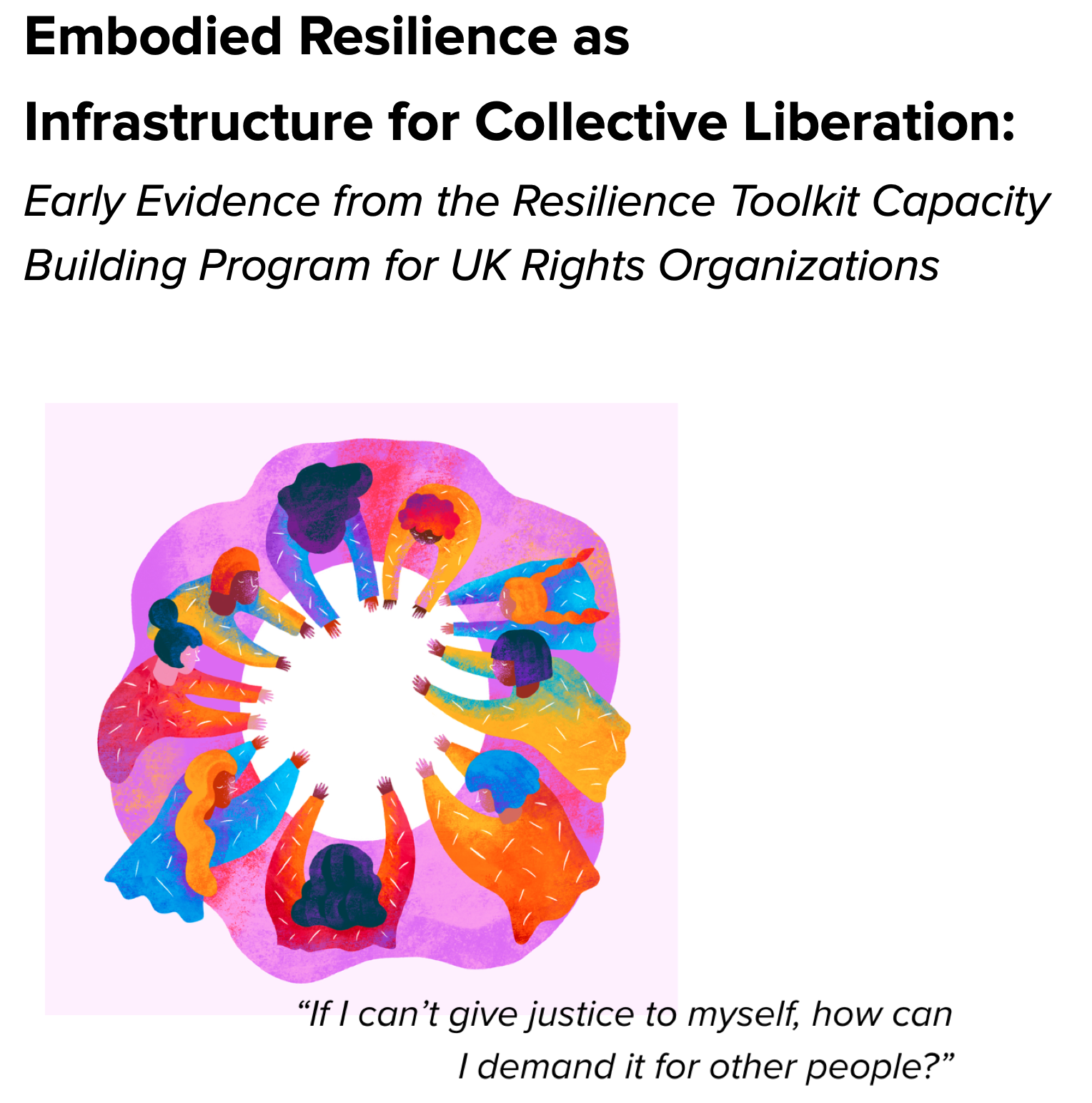
A study by Lumos Transforms, published in November 2025, tracked the impact of embodied resilience practice over 11 weeks with nearly 120 participants from six rights organisations.
The data showed significant increases in internal stability and relational capacity across the participating organisations.
What participants have said
What’s the methodology?
Embodied resilience is a multi-modal approach based on the teachings of The Resilience Toolkit. It combines the following cognitive and embodied elements:
Body-based practices
Simple, portable and adaptable exercises that can be practised anywhere and in under 2 minutes to help the body de-escalate its stress response when it’s safe to do so.
Systemic frameworks
Designed to help you put your own experience into a wider systemic context and illuminate the connection between personal embodied practice and collective action.
Scientific models
Drawing on models from neuroscience, ethology, psychology to illustrate how stress manifests in the body, mind and emotions and how our survival responses are shaped by the conditions around us.
Peer learning
Embodied resilience is an inherently collective approach. Learning, reflecting, co-regulating and building community with people who share similar questions is one of its most potent elements and an anti-dote to individualism.
Trauma-informed facilitation
Trauma often occurs when people have no choice and no witness. Agency, care and collaboration are central to the way I have been trained.
Everything we do is invitational, so you can choose what works for you and let go what doesn’t.

What does a typical programme look like?
I work with teams for an initial period of 12 weeks to lay the foundations, embed the practices into their daily routines and adapt them as we track shifts over time. All sessions are delivered over Zoom, which makes the programme suitable for dispersed teams.
The programme below can be tailored according to organisational needs, schedules and priority themes or issues you would like to focus on.

Month 1: Foundations
1 scoping session (1 hour)
1 learning workshop (3 hours)
3 weekly practice sessions (1 hour)
Learning outcomes:
Building trust and safety across the group (a pre-requisite for practice)
Expanding common understandings of resilience to include a collective dimension
Learning to read signs of stress and relaxation in the body
Distinguishing between fight, flight and freeze
Familiarity with baseline practices

Month 2: Embedding
1-to-1 check ins - optional (1 hour)
1 learning workshop (3 hours)
3 weekly practice sessions (1 hour)
Learning outcomes:
Understanding how survival responses are shaped
Identifying risk factors and protective factors for resilience at work (incl. what can / cannot be changed)
Developing individual and collective ‘tiny habits’ that can fit into the team’s daily routines
Deepening personal understanding and practice (optional)

Month 3: Expanding
1 celebration (1 hour)
1 learning workshop (3 hours)
3 weekly practice sessions (1 hour)
Learning outcomes:
Reviewing and adapting ‘tiny habits’
Identifying and celebrating shifts in individual and collective capacity
Identifying opportunities for further practice
Gathering insights and reflecting on wider implications for the work of the organisation and/or sector
Interested to explore if this could be a good fit for your team?
Why does it matter?
Developing embodied and relational skills is essential internal infrastructure for navigating increasingly challenging environments. The difficulties people face at work, in their own lives and in the wider world require more than a cognitive approach because they impact people physically, mentally, emotionally and spiritually.
The impacts of this show up in different ways. For example:
Staff burning out or acting out from dealing with a lot of stress and trauma in the workplace
People being ill-equipped to deal with internal tensions and conflict, which ends up in relational ruptures
Stressed out managers giving feedback that sends people over the edge
People over-reacting to situations at work in ways that seem disproportionate
Staff turnover increasing because there isn’t the right support in place to help people stay
Leaders wondering how their staff can sustain the organisation’s work under growing external pressure
These struggles are not a sign of failure, but a symptom of the challenging times we are in.
Organisations are working under increasingly difficult conditions, with a huge demand on their services, often perpetual struggles to make ends meet and an increasingly divisive political rhetoric.
In such a context, people’s survival responses are activated a lot of the time, leading to chronic stress, interpersonal conflict, cynicism, burnout and illness. This diminishes the collective capacity of the organisation and the wider sector to change the systems that create the issues they are trying to address in the first place.
Embodied resilience is an approach that recognises the connection between people’s individual experiences and the collective, systemic reality around us and intentionally brings them into conversation. It builds up people’s embodied, emotional and relational capacity so they can show up to collective change work with more presence, stability and flexibility.
In doing so, this approach resists individualising things that are systemic (such as the chronic lack of time and resource) nor does it pathologise normal responses to impossible conditions (such as overwork, exhaustion or dissociation).
With compassion, gentleness and a clear understanding of how systems of power operate, this work invites everyone into a shared process that builds connection, intimacy and trust as well as immediate application into the team’s day-to-day work.