I take a principled stance against Artificial Intelligence (AI), and this post explains why. That doesn’t mean I think you’re a ‘bad person’ if you use AI or that I’m better than you for not using it. I’m interested in what AI is doing to us, collectively.
I understand that many people are required to use AI in their jobs, use it as an accessibility tool or find it helps them cope with the unrelenting grind. Maybe there could be better AI models that are built more ethically. It’s not your fault that these don’t exist and the conversation about AI can therefore feel so binary.
In other words, the damage AI is doing to our world and earth is systemic and cannot be fixed through changes in individual behaviours alone.
Nonetheless, how we engage with AI matters. Everyday resistance to AI is widespread and having an impact. What I generally ask people in my life is not to throw their phone in the sea but to think critically about AI and minimise its use where possible.
Here are some of the main reasons I don’t use AI, in no particular order of importance:
AI has been central in the murder of civilians across the world.
Most of the recognisable names are implicated - Google, Meta, Microsoft, Amazon, OpenAI, Palantir. And they are grossly evading accountability. “[In] the US double-tap attack on a girls’ school in Minab, southern Iran, in February, in which 156 people including 120 schoolchildren were killed […] no apologies were offered, because no one did it. Machine-planned murders come guilt-free.” - Arundhati RoyAI is gobbling up the resources we rely on for survival (water, land, energy, minerals) and accelerating climate breakdown.
According to biodiversity scientist John C. Fleming, “feeding data centres with fossil fuels” is akin to “taking the climate crisis we have now and blowing it up like the Incredible Hulk.” (quoted in Klein & Taylor, 2026)AI steals people’s labour without consent - and then monetises it.
AI doesn’t respect intellectual property. It doesn’t pay the writers, journalists, artists, illustrators, musicians, intellectuals, creators of any kind whose work it used to train its large language models. “The AI business model is based on extraction, prediction and manipulation. Our brains are being rented back to us.” - Rebel Tech Alliance
AI is a fundamentally colonial enterprise.
“The AI industry does not seek to capture land as the conquistadors of the Caribbean and Latin America did, but the same desire for profit drives it to expand its reach. The more users a company can acquire for its products, the more subjects it can have for its algorithms, and the more resources—data—it can harvest from their activities, their movements, and even their bodies." - Karen HoAI is based on eugenicist, white supremacist thinking.
AI companies are racing to build ‘Artificial General Intelligence’ (AGI), a concept which harkens back to British eugenicist Charles Spearman’s theory of the ‘general intelligence factor’ (or ‘G factor’). Spearman believed intelligence could be quantified through cognitive tests and that it had a genetic basis. He also believed people who scored below a particular threshold in his tests should not be allowed to have children. The G-factor theory was used as a foundation for Jim Crow laws in the US in the 1920s.
AI wants to make us less human.
AI’s ultimate promise is to merge flesh and robot in order to create some kind of ‘higher’ human. In the process, it strips us of the qualities that make us most human:AI prevents learning and growth by smoothing over any edges so we don’t have to search for the right words, sit with the uncomfortable feeling or work through some tension.
AI extinguishes critical thinking and creativity by packaging statistical answers as ‘truth’, skipping the process and sucking up the empty space that can hold deep reflection and unmediated ideas.
AI makes us fragile, dependent and immature by hooking us to a 24/7 support line that never argues with us, never challenges us, never asks us to take responsibility for ourselves. When we then encounter each other as humans, we lack the skills to deal with each other’s feelings, needs and differences.
“When we use AI to flesh out ideas, we lose the most important part of the writing process: thinking.” - Eve Fairbanks
AI is a pacifier and a distraction from the basic needs that aren’t being met.
Many people turn to AI because there isn’t anything else available or they can’t afford to pay for a service privately. For example, AI has been pushed into schools as a cheap substitute for proper learning and mental health support (posh schools are going analogue again). AI cannot give people proper education, therapy, food, housing, decent jobs, community, a sense of self-worth. Instead of AI slop, we need to be asking for what we really need.
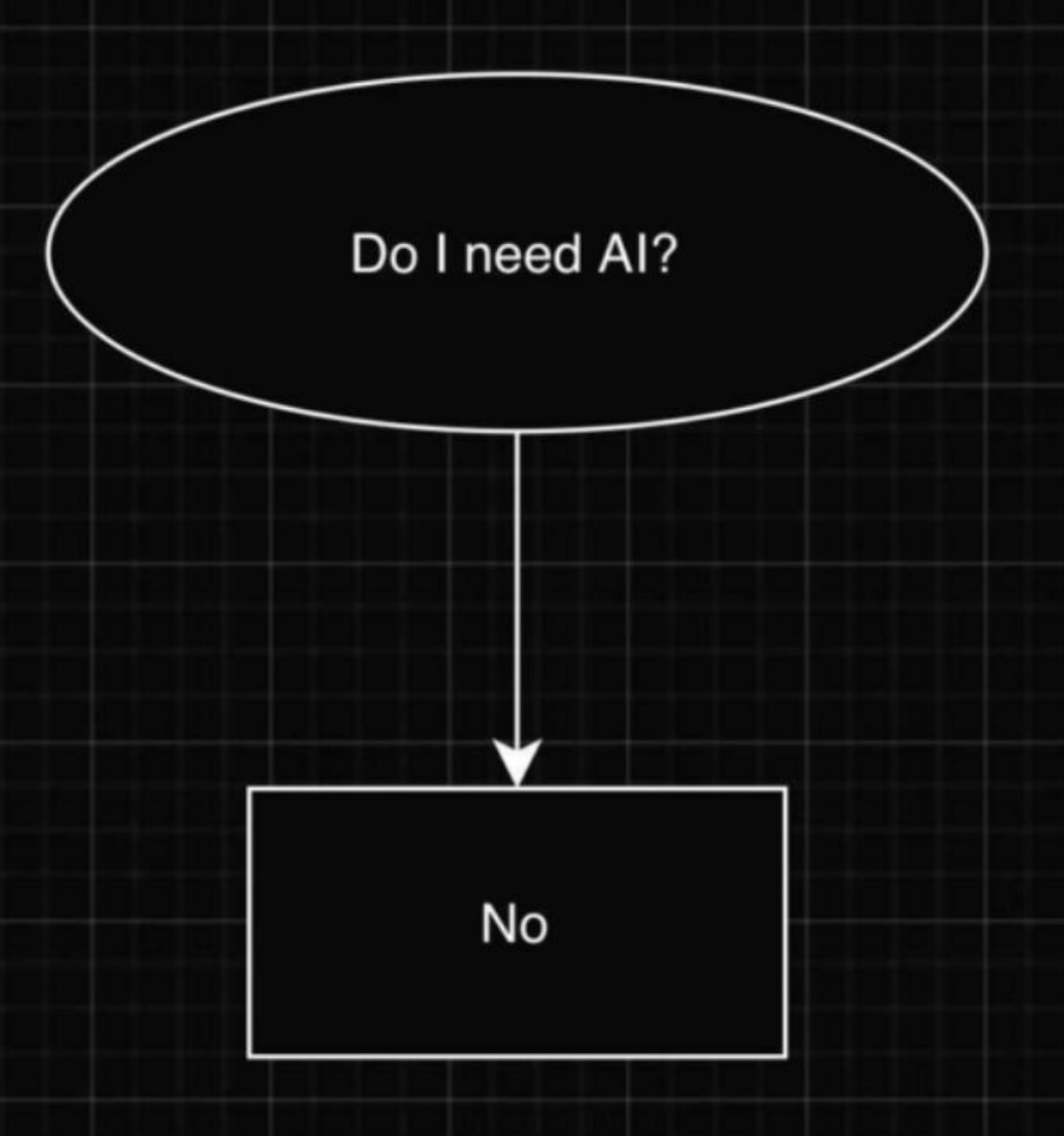
Graphic with a black background and white text in which a bubble at the top asks, 'Do you need AI?', and an arrow points down to a box that reads 'No'. Image credit: Dan McQuillan.
Fundamentally, I believe AI makes us even more disempowered than most people already feel when it comes to their ability to influence what is happening in the world around them.
In a recent interview with Dylan Orchard, who researches everyday resistance to AI, Miriam Partington observed:
“People want agency back over their lives. What does agency look like in a world where a small, insular tech elite and vast sums of investment are guiding decision-making around this powerful technology?”
At a personal level, it can look like refusing cookies on a website or using your grandmother’s analogue recipe to bake actual cookies instead of asking ChatGPT.
At a structural level, it can look like pressuring the NHS and local governments to terminate their contracts with Palantir or blocking new data centres from being built.
At a cultural level, I ask us to consider what should and should not be automated, surveilled, exploited, commodified and why.
In the words of the Kogui people of the Sierra Nevada de Gonawindua, Colombia:
“A world that cannot live in peace and harmony is a world without wisdom. And a world without wisdom has no chance whatsoever of surviving. […]
Wisdom is knowing limits. Understanding consequences. And the ability not to do a thing when it should not be done. Not everything that can be created should be created. […]
Knowing the difference, that is wisdom.”