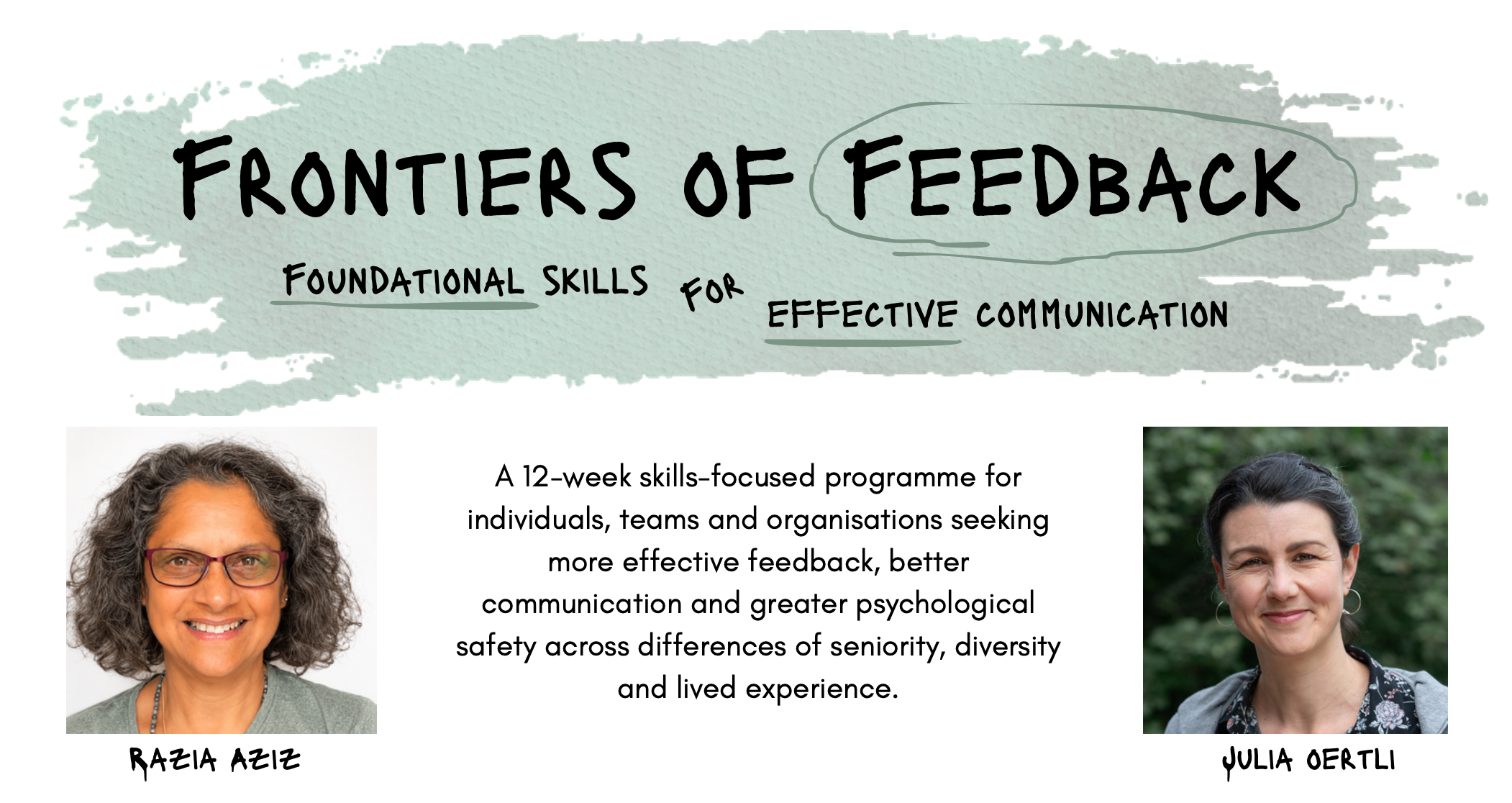
Transform difficult conversations into stronger relationships, more trust and better results.
Do you recognise any of these dynamics?
Important conversations are being avoided
Feedback is shared indirectly rather than openly
Honest critique feels risky
Appreciation isn’t being given
Unresolved tensions simmer under the surface
Trust declines
Misunderstandings grow
These are all symptoms of feedback avoidance.
Don’t worry, you are not alone! It’s something we see all the time:
→ Feedback avoidance creates a culture in which unexamined assumptions, misunderstandings and unspoken frustrations take root.
→ Relationships become vulnerable to mistrust and conflict.
→ When differences of power and influence are in the mix, the impact can be corrosive.

Photo by Resume Genius on Unsplash
This course is here to help.
We created ‘Frontiers of Feedback’ to help you and your colleagues identify, learn and practise effective feedback skills to build stronger relationships, improve collaboration and achieve better outcomes.
What is feedback?
Feedback is the information we give and receive - intentionally and unintentionally - about who we are in relation to others from moment to moment.
We give and receive feedback not just through our words, but through our body language, our tone of voice, our silences etc.
It’s impossible to control all the feedback we are giving and receiving, but we can learn to do so in ways that support mutual growth.

Photo by Resume Genius on Unsplash

A playful way of wrapping your head around feedback and a deeper understanding of what giving and receiving feedback with clarity and intention requires.
Upcoming dates:
Monday, 12 October 2026 from 12-1pm BST on Zoom
Wednesday, 28 October 2026 from 6-7pm GMT on Zoom
Thursday, 19 November 2026 from 12-1pm GMT on Zoom
The session will cover:
What actually is feedback? We’re constantly giving and receiving feedback, but how does it function?
How does feedback show up in the day to day and how can it come out sideways if it’s not done intentionally?
What does the programme look like including schedule, time and financial commitment?
All participation is optional - you can listen, talk in the chat, chip in verbally, have your camera on/off - we welcome you.
Feel free to bring snacks, hot / cold drinks and questions!
What can I expect?
Frontiers of Feedback is a skills-based programme and therefore highly practical: more than one third of contact time is spent in skills practice. We will encourage and support you to embody your learning by applying these skills straight away in your personal and professional life.
As a participant in Frontiers of Feedback, you will learn how to:
✓ Communicate clearly, honestly and authentically
✓ Give feedback with skill, care and confidence
✓ Receive feedback with openness and less defensiveness
✓ Build psychological safety and stronger relationships
✓ Navigate differences in power, identity and lived experience
✓ Listen deeply and respond mindfully
✓ Turn difficult conversations into opportunities for growth
Which enables the following outcomes:
→ Improved communication across difference
→ Stronger leadership capability
→ More effective collaboration
→ Greater creativity and productivity
→ Increased trust and belonging
→ Healthier relationships

Photo by NONRESIDENT on Unsplash
The registration deadline for the October programme is Thursday, 17 September.
What participants have said
Each programme is tailored to the organisation’s specific context and objective. Over three months, Frontiers of Feedback combines individual, small group and whole group learning in a cohort of up to 15 people.
Working with a different theme each month, the course includes the following elements:
What’s the content and schedule?
Benchmarking
Benchmarking questionnaire at the start, end and three months after the programme
Whole group learning
Six fortnightly 2-hour facilitated learning sessions
Small group learning
Groups of 3-5 people meet fortnightly for shared practice and reflection
Skills practice
A third of all time spent in applied skills practice
Individual assignments
Individual tasks, including journalling, to be completed between sessions
1-to-1 support
Optional 1-to-1 coaching support to accelerate learning
The time requirement is a minimum of 8 hours per month, which includes:
4 hours of facilitated learning
2 hours of companion learning
1 hour of journalling
1 hour of personal practice
Example schedule
Month 1: The role of feedback
The role of feedback in relationships
Early experiences of feedback
What makes feedback difficult and why
What makes feedback effective and why
Month 2: ‘Feedback hygiene’
Exploring underlying motivations
Bridging the gap between intention and action
Deep listening and authentic speech
Month 3: Feedback across differences of power
How feedback intersects with diversity
Appeasement and fragility
Equitable feedback practice
To discuss how Frontiers of Feedback can support you, your team or your organisation, join a taster session or get in touch with us to set up an informal call.
Dates for the upcoming open programme cohort starting in October 2026 are listed below.
The registration deadline for the October programme is Thursday, 17 September.
What’s the investment?
In-house programme
For teams or organisations of up to 15 participants, a bespoke in-house programme is £9,732 per cohort.
Exact schedules and content can be adapted to each team’s specific context, needs and learning goals.
Unless agreed otherwise, 2-hour live learning workshops will run every other week on Zoom.
Regular review meetings will be scheduled at the start of the contract.
Optional 1-to-1 coaching is available at £150 per hour for all participants throughout the programme.
Open programme
For individuals, the programme is £750 per participant.
Two bursary places at £150 are available on every course for people on low income. Please indicate in the registration form if you would like to claim one.
There are 15 spots in total. The next open programme runs from 1 October 2026 - 10 December 2026.
We are looking to host the live learning workshops every other Thursday from 10am-12pm GMT. If this time doesn’t work for you, please let us know in the registration form so we can consider adjusting it.
Optional 1-to-1 coaching is available at £150 per hour.
The registration deadline for the October programme is Thursday, 17 September.

Photo by Matthew McBrayer on Unsplash
Key questions answered
-
In principle yes. This programme is structured cumulatively, which means each week, you will learn something that future sessions will build on.
However, life happens, and you may miss parts of the programme due to unforeseen circumstances.
If you know in advance that you can’t attend more than two of the live sessions, we ask that you sign up to a future cohort instead. -
Yes. The self-directed learning and peer practice are a crucial part of the programme because it’s where you start to apply feedback skills in your own life.
Between each live session, we will ask you to:
Meet with your companion learning group for 1 hour (twice per month)
Respond to a journalling prompt, which we will discuss in the next live session
Apply what you have learnt in your own context with specific guidance from us
We estimate about 4 hours of ‘homework’ per month.
-
A £50 deposit (£15 for people on bursaries) is required to secure your place once you have registered. This is non-refundable.
We ask that participants pay the full programme fee before the first session.
However, if you are self-funding and this poses a challenge, please get in touch with us to arrange payment in instalments.
-
We generally only issue refunds if the programme isn’t running - otherwise we treat refund requests on a case by case basis. If you need to cancel and want to request a refund, please get in touch with us directly.
-
Please see Orchid Culture Change’s privacy notice for detail: https://www.orchidculturechange.com/privacy-notice
We ask all participants at the start of the programme to agree to treat what is shared in the sessions as confidential.
Got a question that isn’t answered here? Get in touch
Who are the facilitators?

Razia Aziz (she/her) is a consultant and facilitator, holistic coach and creative practitioner. She has supported thousands of people in and beyond organisations to grow and thrive by developing creative, conscious agency at the level of self, relationship and system.
With a wealth of experience in Diversity, Equity and Inclusion, she has worked across sectors with frontline staff to senior leaders — creating reflective and courageous spaces for learning and relationship building.
Combining practical tools with deep respect for lived experience, she supports people to reconnect authentically and compassionately with themselves, others and the wider world, restoring creativity, resilience and purposeful leadership.

Photo by Livio Salvi
Julia Oertli (she/her) set up Orchid Culture Change to help teams create cultures that match their bold visions for systemic change. She has over 13 years experience in the UK public, philanthropic and non-profit sector where she has supported teams and whole organisations to navigate change and uncertainty by centering connection, equity and courage.
Julia is a certified facilitator of The Resilience Toolkit, a trauma-informed approach to building stability, capacity and coherence in people’s nervous systems so they can navigate challenges without burning out.
She has used this method to support individual leaders, teams and organisations to expand internal capacity and possibility during periods of high change.
Together, Razia and Julia bring extensive experience of helping individuals, teams and organisations develop courageous, compassionate and equitable relationships and cultures.