The power of our broken hearts
Content note: genocide, colonial violence
Three years of witnessing apocalyptic violence unfold in Palestine (and more recently Lebanon) in the most inhumane ways imaginable, carried out with the steady support by our governments and almost no meaningful intervention by the international ‘community’ does something to our collective psyche.
We are social creatures, and witnessing violence against others without being able to stop it or intervene injures our moral compass.
In Dr Gabor Maté’s words: “It’s impossible to have your eyes open and not to have your heart broken.”
On 24 September 2026, dozens of protesters (some well-known actors and politicians) were arrested outside the UN General Assembly in New York, while inside, war criminal and ICC fugitive Benjamin Netanyahu walked across the red carpet to deliver a speech in which he claimed accusing Israel of genocide was “the greatest lie of the century”.
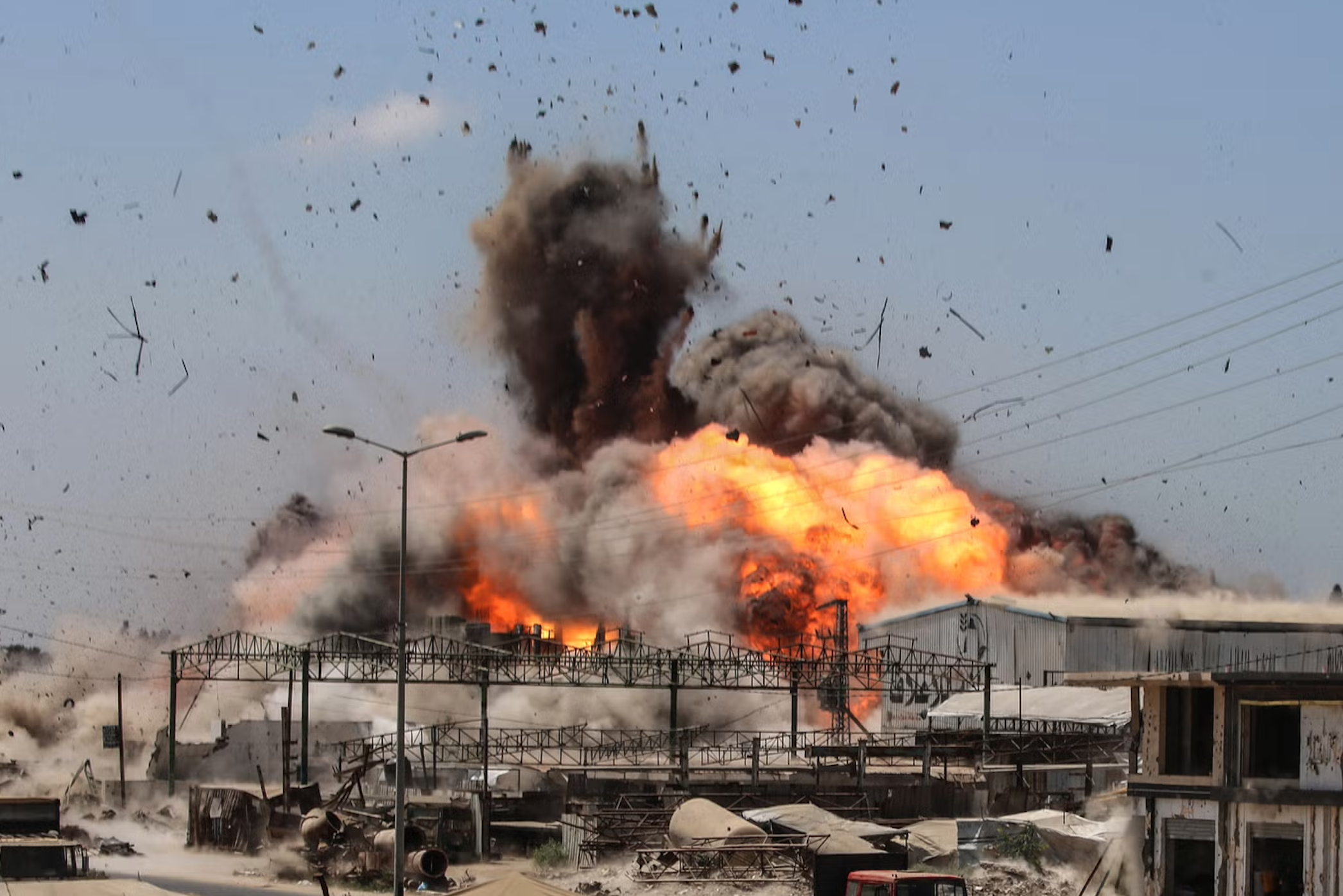
Smoke and a fire ball rise during an Israeli strike, carried out in the area of al-Zawayda, in the central Gaza Strip on 23 August 2026. The airstrike killed two people, including 4-year old Muhammad Abdel Salam Taha. (AFP/Getty)
The absurdity of a situation like this is directly connected to the actions and pressure millions of heartbroken people have exerted on their leaders to do something. The greater the public pressure, the heavier the crackdown on protest and the steeper the lies that try to justify an on-going genocide.
Even though we haven’t been able to prevent or stop the violence in its tracks, our broken hearts are a powerful force in the world.
While polling in countries most closely aligned with Israel’s government is showing a dramatic shift in public opinion away from support for Israel, our leaders keep are having to go to ever greater lengths to try and fool us into thinking what they are doing is morally justifiable, or even necessary.
For example, a year ago, Trump declared a so-called ceasefire and appropriated the language of ‘peace’ in an attempt to take the future of the Gaza strip into his own hands. Since then, Israel has continued to kill Palestinians every day and block the entry of life-giving and life-saving things like food, medicine, shelter, fuel, machinery and spare parts.
While the commercial ‘Board of Peace’ (membership can be bought at $1bn per year) has failed to implement even the first steps of its own reconstruction plan, its function was to serve as an elaborate smokescreen to divert the world’s attention elsewhere.
Similarly, whistleblowers have revealed that the Israeli military routinely engages in ‘retrospective reframing’, which consists of explaining away the killing of civilians, healthcare workers or journalist by claiming that they were ‘affiliated with Hamas’ (which is code for ‘terrorist’ or ‘subhuman’).
Don’t these kinds of manoeuvres designed to obscure or justify the violence point to the fact that its perpetrators know there is something immoral to hide?
Ta-Nehisi Coates spoke about this in an interview with Mark Lamont Hill in October 2024, one year into the genocide. He put it like this:
“Human beings are not really good at seeing violent immorality for what it is and saying, ‘I’m going to do exactly that’. They usually need to obscure it in some way. They need to believe that the victim is somehow not human, that it’s not happening. […] I think [our need for stories to justify violence] speaks to some sort of consciousness.”
In Coates’ book that came out the same month, he reflects on a recent visit to Israel: “To construct what amounts to a wall of devouring, you must be really afraid of something.”
What is that something?
I believe, at its core, it’s our shared humanity. It’s the bridge that would allow now two deeply traumatised peoples (Jews living in Israel and Palestinians) to live as neighbours and as equals. It’s the force that would dismantle the hierarchy of humanity that defines Israeli apartheid by placing Jewish Israelis above anyone else.
Many people feel the wrongness of it all viscerally in their bodies. And, on some level, they understand that this isn’t unique to Israel either, but a colonial pattern with deep roots, experienced by many peoples around the world.
The USA and the British Empire were founded through the violent expulsion, enslavement and sometimes near-total extermination of the indigenous peoples who lived on these lands.
Before that, the peasants of Europe were brutalised into submission to do factory work and forced to surrender their lands in order to accelerate the ‘civilisational progress’ of the industrial revolution.
All of these violent rampages were preceded by the dehumanisation of the people about to be occupied, killed and dispossessed, painting them as ‘primitive’, ‘uncivilised’ or ‘heathen’.
This is what many of us see when we look at the actions of the Israeli state today.
As recently as August 2026, Israel’s Minister of National Security, Itamar Ben-Gvir, openly advocated for “targeted assassinations” in Gaza “taking down 30 to 40 every night”, and justified this by insisting that “there are people there who are not worthy of life. They shouldn’t live. They’re not even people.”
In September 2026, Finance Minister Bezalel Smotrich called for the full-scale genocide to be expanded to the occupied West Bank.
In these and other examples of officials dehumanising Palestinians, we hear the echoes of the violent conquests, occupations and genocides that came before this chapter.
It’s deeply upsetting, not just for what is happening in front of us in real time, but also for what it represents.
“This regime is against the balance of the universe”, Ahmed Abu Artema, one of the organisers of the Great March of Return in Gaza in 2018, said in a recent interview.
At the start of the genocide, Abu Artema was targeted by the Israel military, who killed his son in October 2023. When he was finally evacuated to the Netherlands, Abu Artema wasn’t allowed to take anything with him, not even the comb and Quran that reminded him of his late son.
The injustice and heartbreak we feel when we hear this and so many other stories from survivors of this genocide is precisely the sentiment that threatens not only the Israeli state and its genocidal machine but also its backers and supporters, who themselves have long records of violence and dispossession.
Our broken hearts reflect a deeply human instinct, one that wishes to safeguard everyone’s right to safety, freedom and self-determination - through struggled political negotiation sometimes but never at the expense, dehumanisation and oppression of another people, whatever their faith.
As journalist Nora Barrows-Friedman from the Electronic Intifada put it:
“The reason that it’s so hard for most of the world to comprehend that kind of cruelty [committed by the Israeli regime] is because we haven’t lost our humanity.
It is a testament to our very broken hearts that this kind of sadism is unimaginable to us, even after so much we have seen live-streamed over the last three years.”
This keeps me going. Because our shared humanity isn’t something fanatical politicians and power-hungry tech billionaires can legislate out of existence, delete from the internet archives or beat out of our bodies.
It is something we can choose, practise and reinforce each day. And in the face of end times fascism, its power cannot be understated.