Efficiency is killing us
As I was struggling with the onset of burnout in the midst of the third heatwave of the year, I began hearing what sounded like the voice of an irritated teenager in my head.
It was sharp, piercing and clear in its message, and it grew louder and louder as the days went on.
“I don’t want to be on time.”
“I don’t want to follow a schedule.”
“I don’t want to tick off a to-do list.”
“I don’t want to multi-task.”
“I don’t want to do anything you tell me!”, she screamed.
My training - particularly in embodiment and Processwork - has taught me not to banish these kind of prickly voices into exile but to start paying attention instead.
So I began to listen. I realised that what I was hearing was in fact not a teenage protest about defying authority and claiming independence, but something that felt more like a vital and astute warning sign.
When I translated my inner teenager’s refusals into adult language, what she was saying was something like:
“You’re on the brink of burnout, this is the time to slow down before nothing moves any more.”
“The expectations you place on yourself and on your time are creating such an amount of unnecessary stress that you are harming your health.”
“This striving for efficiency is part of an unsatisfiable culture that fetishises growth above all else. Be careful because it will eventually eat itself, including you.”
I took what I heard as seriously as I could.
On days when I didn’t have many fixed commitments, I gave myself space to move in a less rigid and planned way. I took naps when I got tired. I didn’t follow the same predictable routine so there could be more spontaneity and surprise. I sat quietly by my window for a few minutes every day, doing nothing.
As I tried to counteract the doctrine of efficiency in my own small ways, I began to notice the extent to which it governs our lives.
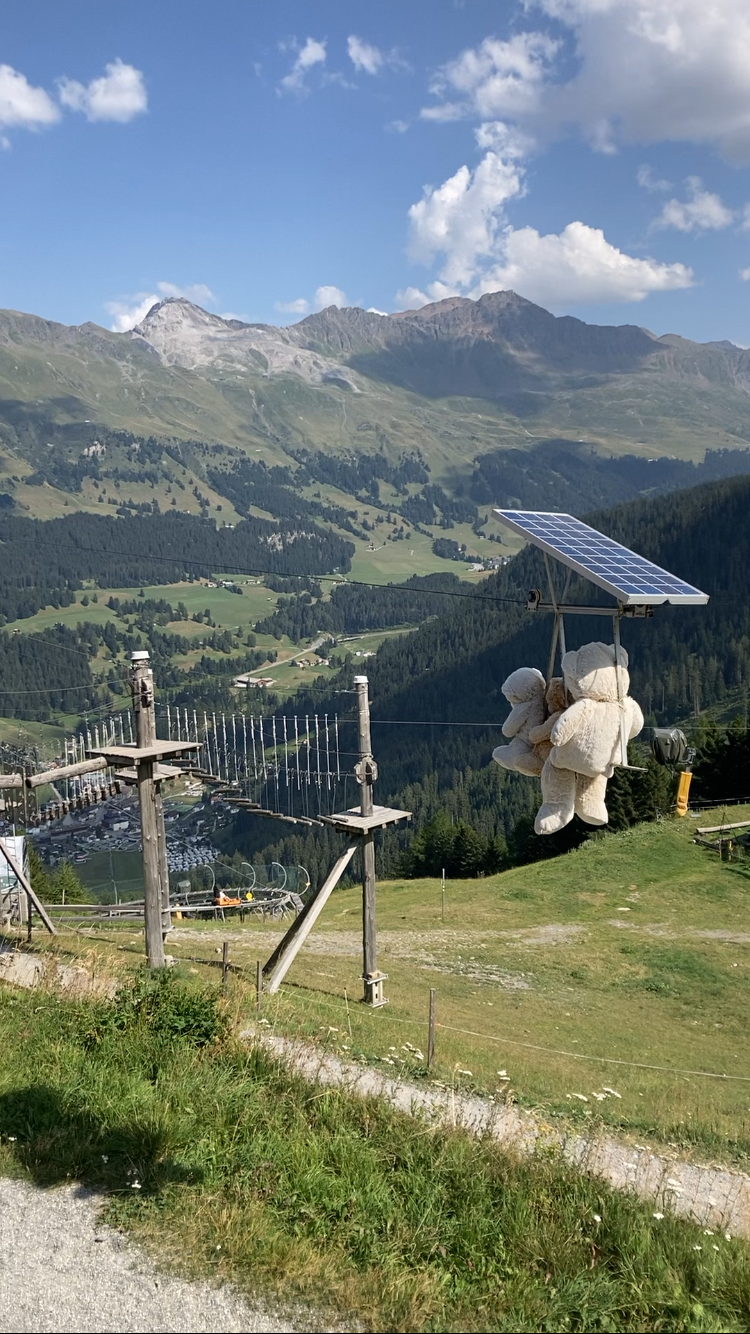
Photo of three teddy bears on a cable car powered by a tiny solar panel fixed above their heads overlooking a valley below flanked by cedar forests, green pastures and a rocky mountain range above in front of a blue sky.
One of the starkest examples of this right now is the creeping, sweeping rise of AI, which millions of people seem to have embraced without asking too many questions.
In a brilliant piece about the characteristics of AI writing, Eve Fairbanks lays out why striving for efficiency in writing is a total fallacy:
“We tend to believe that efficiency is the highest virtue, the four-hour workweek the ultimate goal. Why sweat over the introductory paragraph of an essay if an AI program can sail over whatever argumentative obstacle you have in the space of 15 seconds?
But the effort and the hang-ups are, as they say, a feature of the human thought process, not a bug. When human beings write, we judge ourselves; we stop; we backtrack. In published writing, the traces of this process are erased.
But it is the process that makes human writing sensible and meaningful. Many authors describe how, when they’ve finally hit on the right idea, writing feels like going down a water slide; putting one sentence after another becomes easy.”
I think this applies not only to writing, but to living itself.
The ‘efficient’ way to deal with my inner teenager would have been to shut her up by pressing on, to intoxicate myself to such an extent that I couldn’t hear her any more or to stubbornly pretend she wasn’t there at all.
In doing so, I would have missed not only the essence of the message but the warning signal that prompted me to change my behaviour and slow down.
The most important things are often not obvious at first. Life requires us to grapple - sometimes wrestle - with complexity, desires and contradictions and to brew, process, navigate, ponder and ruminate.
Our obsession with efficiency kills any possibility of reaching those deeper truths.
And that is killing us in turn - because if there is anything that can guide us in figuring out how to become responsible, honourable inhabitants of this planet, it is the deeper, ancestral truths, memories and practices we carry in our bodies.
This is something we know in our bones. According to Fairbanks, the promise of efficiency is a key reason we feel uneasy about AI:
“The problem is that the efficiency and frictionlessness that make AI appealing to writers are the same qualities that make it feel untrustworthy to readers.
And readers are right not to trust it. No matter how much we may tell ourselves that AI is just a tool like spell-check, it isn’t. When we use AI to flesh out ideas, we lose the most important part of the writing process: thinking.”
When we measure everything according to ‘value for money’, we lose that which makes us human: wonder, creativity, connection, spirituality, awe, playfulness, deep feeling, intuition, the capacity for complexity and change.
It is one of the many reasons why I stay away from AI where I can.
I’m not saying there is no place for using time wisely, rigorously and with focus. This will be an extremely important skill the more urgent the crises we face become.
(For example, if Thames Water and other UK water companies fixed the leakages in the Victorian underground pipes, we could save around 20% of treated water. This seems paramount, particularly in the midst of widespread drought.)
But when efficiency becomes one of the governing values of our world, it can literally suck the life out of us. Because there is no end to efficiency; we can maximise our time to until we die. And I suspect few people will harbour regrets about not having been more efficient on their death bed.
At the end of a leadership course I attended a few years ago, one of my fellow participants had the following parting gift or me: “I give you a permission slip to be messy and useless at least once a day.”
My protesting teenager reminded me of this precious gift. I’ve been using it, in my small ways, but which still feel subversive to the logic of efficiency I have been so conditioned into following.
In my heart, I have made copies of the permission slip and extended them to you and everyone else.
We are not machines. We are glorious humans whose precious lives are about so much more than what we manage to get done in an hour or a day or even a lifetime.