Unlearning eugenics
As temperature records are being broken across Europe for both May and June, I keep wondering how we resist the apathy that can come from framing this as our ‘new normal’.
By this I don’t mean escaping the reality of the climate crisis, the deadly impact heat can have and figuring out ways to mitigate and adapt. But recognising that this is the consequence of decades of inaction on reducing our emissions, years of underinvestment in appropriate infrastructure and adaptations that would help people cope in extreme temperatures, and slipping political priorities that mean there is always something more pressing than, well, ensuring the basis of our collective survival.
As I’m watching people ‘keep calm and carry on’, the echos from the covid pandemic feel loud. For example, key workers having to go out in unsafe conditions that put their health at risk, with no measures in place.
I asked my post delivery person how they were coping in the heat, and if they were getting any support from their employer. “They don’t even give us bottled water”, they told me. “We were sent out early today to avoid the worst of it, but other than that, there isn’t really any support.” It was just after 12pm and about 35 degrees outside.
The message is: If you can’t cope with the heat, it’s your fault. You’re not in the right job. You need to change, not the system or the conditions around you.
We heard this over and over in 2021 as governments attempted to lure us back into public life despite covid still being rampant while most public health measures had been dropped. The message was: If you have a weak immune system, just don’t go outside. If you get seriously ill from an infection, develop long covid or die, it means you have a weak immune system and shouldn’t have been outside.
It’s a cheap way of offloading collective responsibility. It ties in seamlessly with a neoliberal ideology that sees the individual as the main locus of power, and the state a necessary compromise, which should intervene as little as possible.
There’s an inevitability associated with it - that’s just the way it is now. There’s nothing we can do.
This, of course, makes it so much easier to impose a ‘new normal’ on us, whether it’s unbearable temperatures, a serious virus freely circulating or AI making us all dependent on the tech mafia for our everyday functioning.
The message about AI is: If you don’t adopt it, you will be left behind. Rather than fighting for your job or your industry or your rights, you should be looking ahead and embrace the new technology that is destroying your livelihood, stealing your ideas, making a mockery of human rights and further wrecking our planet.
I feel the crushing weight of this hyper-individualism closing in on my chest. How could my health, my wellbeing, my rights and my economic survival be 100% down to me?
What troubles me even more is that there is a direct line from this logic to the pseudoscience of eugenics, which was developed in the late 19th century and set out to ‘prove’ that the genes of white, able bodied cis men were superior to everyone else’s. (Its proponents were, unsurprisingly, a group of white, able bodied cis men.)
Most people today would vehemently denounce this as a harmful and outdated way of thinking, which was used to justify colonial and gender-based violence (and more). But while eugenicists are not as public as they once were, their movement is alive and kicking. Some of their proponents are Silicon Valley titans and have been instrumental in creating and advancing AI.
Their thinking has infiltrated our politics, our economics, our social norms and our collective consciousness to an extent that makes me shudder to think about.
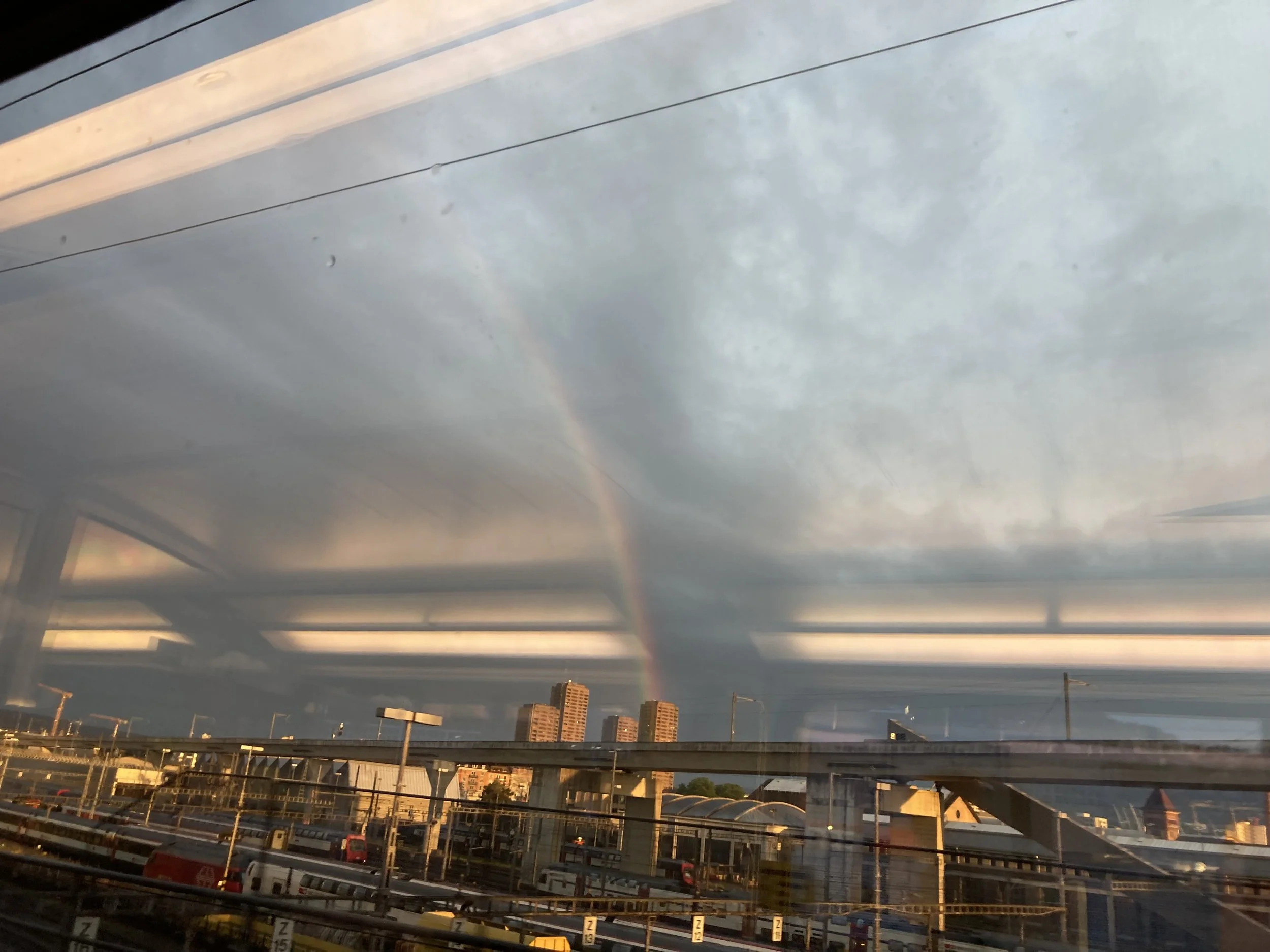
Photo taken through a train window of a fuzzy rainbow in a sky with dark clouds over skyscrapers and train tracks glowing in the evening sun.
It might sound harmless on the surface, but phrases like:
‘Heatwaves are the new normal’
‘We have to live with covid’
‘AI is inevitable’
- in the absence of any meaningful systemic mitigation - are code for ‘survival of the fittest’. The message is: If you don’t make it, that’s too bad, but there is nothing we will, can or should do about it. It’s just ‘nature’.
At what point do we stop normalising that which is killing us?
The climate crisis, pandemics, AI, genocides, political violence, state abandonment - none of these are ‘natural’ causes of suffering and death. They are the consequences of human choices and actions, which we are now conveniently trying to pass up to ‘nature’ (or ‘genes’).
Unlearning the imprint eugenics has left on our politics, our culture, our economics and our psyche means cultivating a deep, unconditional reverence for life, freedom and dignity.
In my mind and heart, this looks like:
Considering nobody disposable, regardless of race, gender identity, disability, age, faith, sexual orientation, class status, trauma history, body size, immigration status, nationality, occupation, social status, physical appearance, achievement or contribution. We are all worthy of life.
Recognising our non-human kin as sacred rather than pets, assets or resources to exploit. Our survival depends on each other.
Acknowledging what gives us life such as water, earth, sun, clean air, connection, laughter, meaning, awe, children, beauty, collective endeavours… and protecting and caring for it.
Understanding my own life as inherently precious, regardless of what I ‘do’ with it. or how much I ‘produce’, The inherent worthiness of life is non-negotiable.
Those are big and deep shifts I’m having to affirm and relearn, probably for the rest of my life. Materially, I try to do some small, everyday ways to resist the pull of the-weakest-will-die-and-it-has-nothing-to-do-with-us thinking. They include:
Putting out a bowl of water for the wildlife around me while it’s hot. They didn’t create the climate crisis and need our help.
Staying home when I’m sick and wearing a mask to protect myself and others. The level of sickness and long-term disability we’re seeing isn’t normal. We have simple, effective tools to prevent it from getting worse.
Limiting the use of AI and asking questions about its necessity, its use of data, its ethics, its impact on human rights and the planet, particularly with people close to me.
Eugenics is based on the imagined supremacy of a very small group of people. The majority of us are not in that category - and even if you are a cis white man, that status is conditional. If you get sick or disabled, if you are queer or poor or sensitive or rebellious, you won’t be protected either.
I want to live in a world that doesn’t categorise us according to a made-up hierarchy of humanity. I want to live in a world in which our lives matter inherently, regardless of how we choose to live them.
As eugenics is reasserting itself in politics, public health and tech, our small acts of resistance and the longer work of rejecting and unlearning its premises inside ourselves matter hugely. Because it’s only from a different internal place that we will be able to build something that doesn’t resemble its harmful legacy.