At what point do we move beyond ‘normal’?
The UK is experiencing a heatwave that is longer than anything the country has seen since records began.
Everywhere is hot and sticky, people are sleep deprived, exhausted and badly behaved, while hospitals struggle to keep up with heat-related incidents and equipment is breaking down in high temperatures.
We have an amber heat health alert that advises people to avoid sun exposure between 11am and 3pm and offers some tips and warnings around how to stay cool and what to avoid.
The Mayor of London announced a heat plan during the second wave in June, which includes some longer-term adaptations such as retrofitting high-risk homes or making transport infrastructure more heat resilient.
Other than that, it’s pretty much business as usual.
People are expected to go to work, particularly key workers. Bus drivers are sweltering in the heat. Schools are open. The Royal Mail employee who delivers my post was still going up and down the stairs in 30+ degrees. No, him and his colleagues weren’t really getting any support, he said when I asked how he was coping.
We keep calm and carry on. But up to what point? At what cost? And who decides?
The human ability to adapt to adverse conditions is phenomenal and can make us incredibly resilient. This is a capacity we absolutely need in order to find our way through this time of great consequence.
But there comes a point at which we tip from 'adapting to change' into 'adjusting to injustice'. We normalise things that should never have been considered acceptable in the first place. For example:
Over 1,000 days of genocide in Palestine with no meaningful intervention
Race riots across the world, stoked, among others, by elected officials
More than 7 million people dead from covid and pandemic preparedness is being dismantled
Deepening economic hardship that is creating hunger in every part of the world
Illegal wars with no public mandate
Climate crisis-induced heatwaves, droughts, fires, hurricanes, flooding
The scapegoating of trans people
The weaponisation of migration (mostly as a result of the above)
The lie that AI will bring safety (through theft and colonial exploitation)
The list is much, much longer.
The point is that in the areas that govern our collective survival - our safety, our earth, our health, our human rights, our freedoms - there have been no ‘red lines’ that would have led to some kind of turning point.
With every massacre, every catastrophe, every natural disaster, there are statements, inquiries, sometimes individual punishments that give the veneer of change while protecting the status quo.
Instead of treating our many crises as wake-up calls, we have become accustomed to a level of violence, injustice and destruction that is, I think, eroding our sense of humanity.
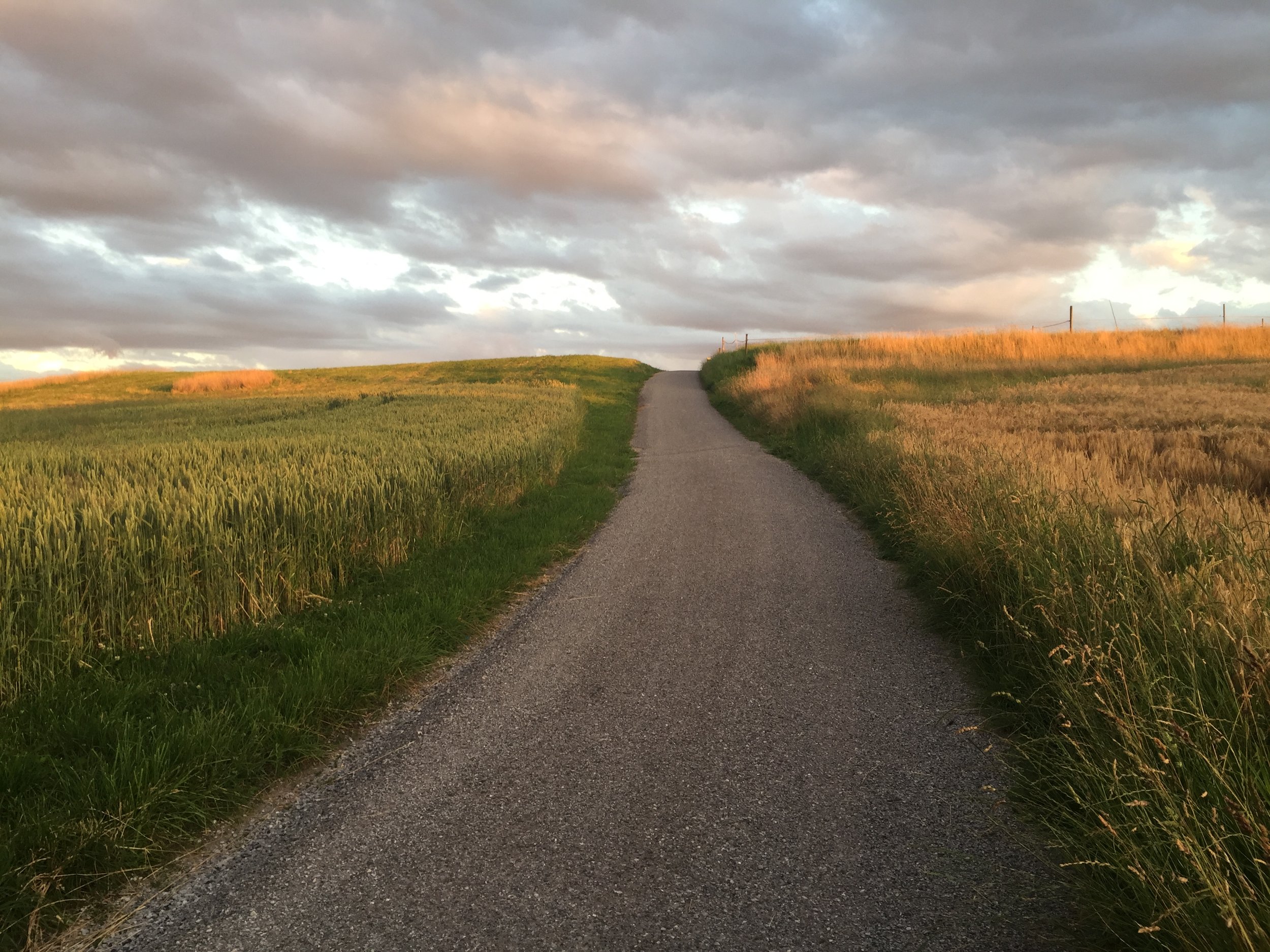
Photo of a gravel path flanked by corn fields leading up a hill, meeting the horizon at the top with grey clouds overhead.
The dominant culture we swim in is so steeped in denial and avoidance that I'm seeing us lose the ability to differentiate between inevitable change and human-made catastrophe.
We have re-normalised eugenics. We are trying to justify the way things are because we can’t bear the truth of what is happening. Instead of challenging what is in front of us, we adjust and carry on.
And in our attempts to 'get through', we forget that none of this is inevitable.
We forget that could have a world in which all of us get to belong, be safe, fed, housed and cared for. That there is enough here for all of us if we figured out a way to distribute the abundance of this earth more equitably. That if we organised our economy differently, we wouldn’t have to sacrifice so much just to stay alive.
We forget that it's the choices we have made collectively (with some people having access to much more power than others) that have led us to the world we inhabit now. And that, therefore, we can make choices now that lead to a different one.
By taking this society at face value we become agents of its values and it destructive nature ourselves. James Baldwin knew this decades before the escalation of crises we are seeing now:
“People who shut their eyes to reality simply invite their own destruction, and anyone who insists on remaining in a state of innocence long after that innocence is dead, turns himself into a monster.”
As most of the UK is sweltering under a seemingly never-ending heat dome, I’m wondering, how far does our definition of 'normal' stretch? Where is your red line?
And if you find that we have moved beyond it, what does this mean for your participation in this world? What agency do you have to shape where we go from here?
These are crucial questions of our time. They are about who we are choosing to be now and, thus, what future we make possible from here on.
World-building starts on the inside, in a quiet place hidden from public view, where we get to decide for ourselves what we consider acceptable. And then let that guide the choices we make.
And heaven knows there are more choices than to simply 'keep calm and carry on'.