System justification amidst rising fascism
Whenever I start a process with a new team or organisation, who have brought me in to support them with their team dynamics or organisational culture, the initial courage and enthusiasm is usually followed by some form of denial.
It often looks like people saying a variation of, “oh, we already have regular team check ins”, or “we can be very open and honest with each other”, or “the relationship with our trustees is very positive for the most part”.
This can feel quite confusing. If I took what people said at face value, I could pack it up and go home. But my job is to get underneath the surface and understand why, if things are going so well, have I been brought in?
This requires working through several layers of resistance, and denial is often the first one up.
In thinking about denial, I’ve realised that at its core is something deeply human, tender and dangerous in equal measure.
As social animals, we want to believe that what we are a part of is fundamentally good, kind, in tact. Being faced with contradictions, injustices and mistruths destabilises us in a profound way.
Lying awake the other night, I remembered a paper I read as a student that haunted me for years. It was called ‘A Decade of System Justification Theory: Accumulated Evidence of Conscious and Unconscious Bolstering of the Status Quo’, written by John T. Jost, Mahzarin R. Banaji and Brian A. Nosek and published in 2004.
In it, the authors examine psychological responses to an existing social order. And they find that the more unequal a situation, the more prominent ‘system justification’ becomes as a means to reconcile harmful structures that seem impossible to change.
In other words, the greater the injustice, the more likely we are to look for a way to justify its existence.
Because the dissonance of injustice affects us deeply. Humans have a profound need to not only feel good about themselves but also the system they live in.
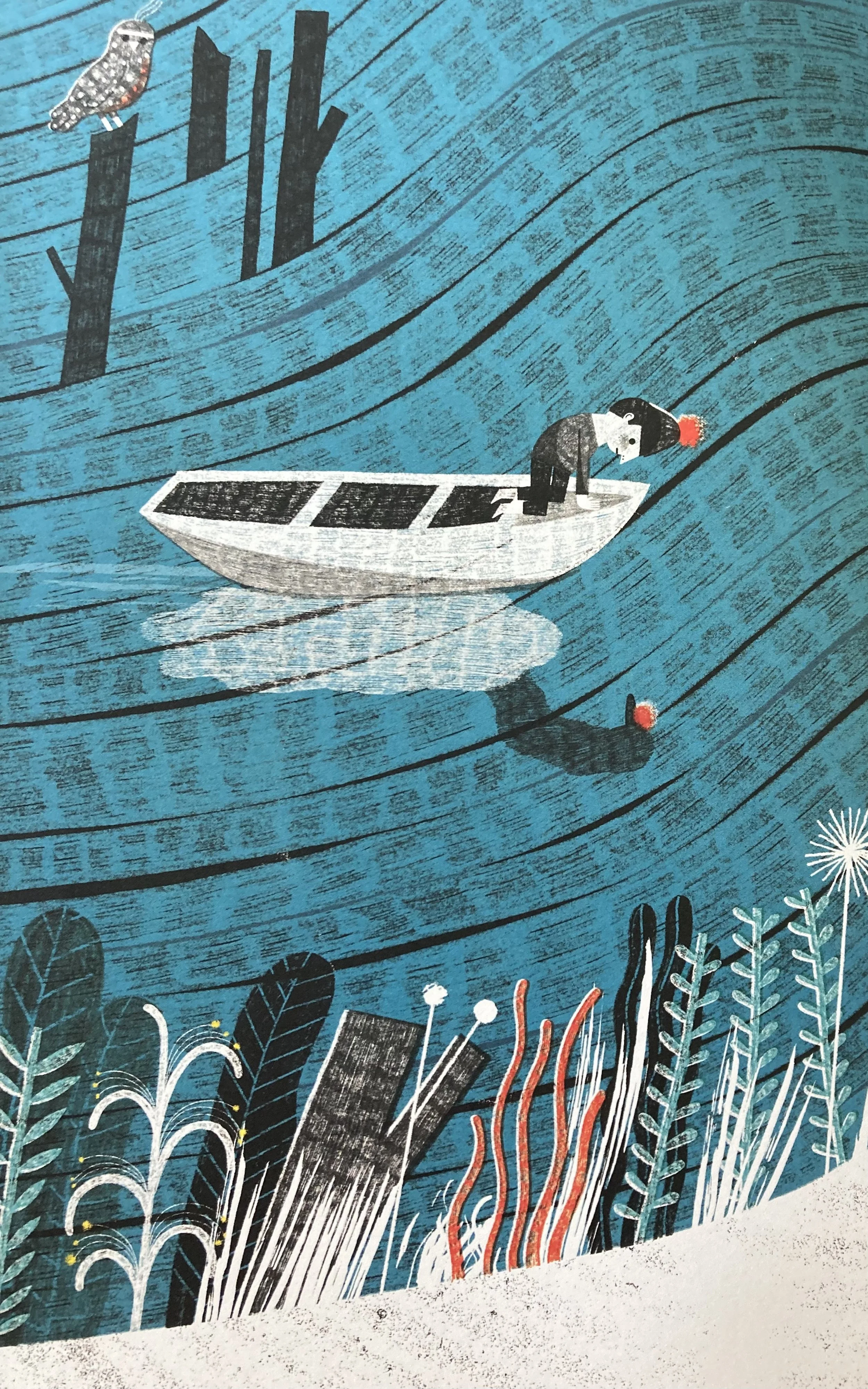
Art by Paloma Valdivia from the Book of Questions depicting a child on a boat gazing at their reflection in the blue water, with various plants growing along the shore and an owl sitting on a tree stump poking out of the water.
This instinctively made sense to me as an eager 20-something student coming up through the wobbles of the financial crash. Staring in the face of a mess we can’t change as individuals can feel overwhelmingly bleak.
Justifying it is one way to create at least some semblance of coherence that allows us to carry on. And denial is perhaps our most accessible tool in trying to remain inside systems that are unjust, illogical, inequitable.
It’s understandable. It’s deeply human. And it’s incredibly dangerous because it allows these very systems to continue unchallenged.
Denial at a team level might not have the most far-reaching consequences. But teams are also microcosms of the world, where the same dynamics are playing out in small ways. So I pay close attention to the function of denial and tread carefully as I know there is a lot at stake.
Because when we extrapolate out and look at the things we have collectively allowed to happen in this world, the system is appearing increasingly unconscionable.
For example, how on earth can we defend allowing a second fascist rally to happen in central London while politicians justify its openly racist claims as ‘legitimate concerns’?
The violence and demonisation against people with less power we have normalised terrifies me. It’s the consequence of an expiring story of separation and expendability that we have justified for so long.
Recognising that we’re drunk on denial is key. Because we can’t face something we’re not willing to recognise.
But sitting with the reality of it can be overwhelming. So how do we do that without trying to justify or deny what is happening?
“We have good reason to be cautious, to be quiet, not to rock the boat. A lot of peace and comfort is at stake. The mental and moral shift from denial of injustice to consciousness of injustice is often made at very high cost.”
There are no easy ways. The starting point is always to first recognise that we are in a response and find some compassion for it.
Like any survival strategy, denial and system justification are inherently protective. They’re trying to keep us safe - whether or not they are effective at doing so is another matter.
If we can start there, we can then ask whether the response we’re having is actually helping us be safer and build the world we want.
And may we do so with compassion. Ripping off the plaster rarely works when it comes to our survival patterning.
If I respond to my client by saying, “that’s wonderful to hear, tell me more about your team check ins”, it usually doesn’t take long before people begin to talk about the challenges too.
I’m still learning this. Being gentle with each other doesn’t mean we’re weak or not clear about our values. It means we understand human nature and our fundamental need to belong to something we can stand by.
May you be gentle with your denial and that of others.