Long vision
If, in 50 years’ time, I had to describe to someone what it felt like to be alive right now, I would probably cite overwhelm, numbness and exhaustion as some of the most widely shared emotions of this time.
Which, in the face of so much destruction, uncertainty and change, makes complete sense. What’s happening in our world is also mirrored in our bodies and in many of our individual lives, and is all decisively too much.
We’re not supposed to ‘live with’ or adjust to the levels of violence, dehumanisation and destruction that is taking place all around us.
The coping mechanisms many of us reach for - denial, blame, justification, domination, perfectionism etc. - are understandable responses. We can hold them with compassion while understanding that most of these coping strategies don’t help us face reality with clarity and courage.
Instead, they leave us dissatisfied, cynical or at the edge of our capacity.
I see people burning out around me all the time. I include myself in this group, frequently circling the edge of some kind of shutdown.
If burnout needed a nick name I’d call it ‘never enough’. There is endless suffering in the world, ever-expanding needs to tend to, and a bottomless list of tasks to get there. If you’re someone who feels a lot, who has a clear moral compass, who cares deeply about the world you’re a part of and who is prepared to take on responsibility, ‘never enough’ will likely find you.
It is too much, and you can’t do it alone. Burnout and individualism are deeply entangled - I’m not sure one could exist without the other.
Burnout comes with a sense of being isolated, on your own, carrying it all on your shoulders, which produces that crushing feeling of ‘never enough’. Because no matter what you do, there will always be more - and you only have yourself to count on. So the monster feeds itself.
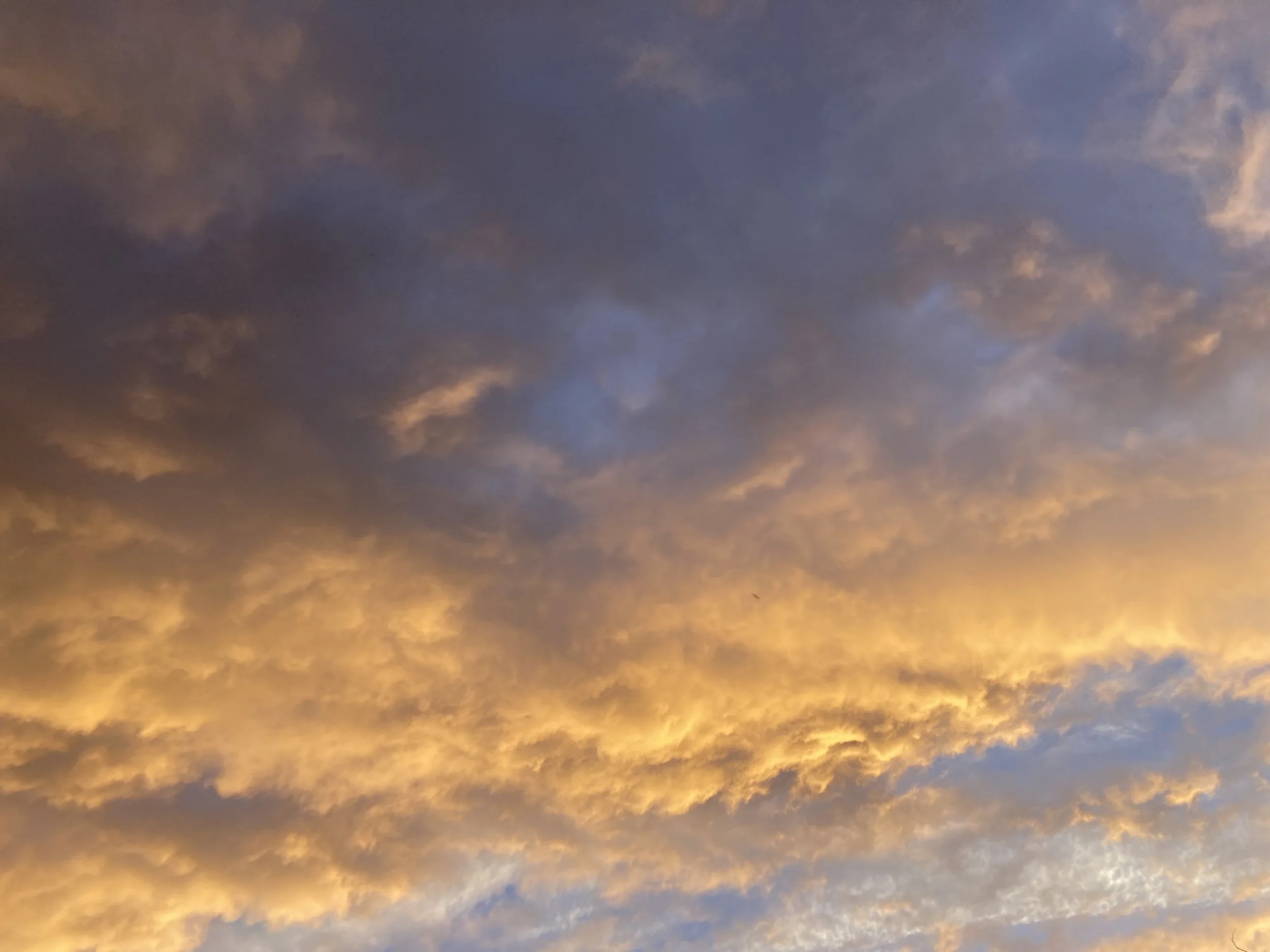
Photo of a stormy sky with some of the grey-blue clouds lit up in yellow by the evening light.
My chest tightens even writing about this. It’s an awful place to find yourself in because it doesn’t offer you any compelling vision, faith or connection to hold onto as you try to climb out of the hole. It’s just you, drowning in the never-ending pile of ‘shoulds’.
Connection is almost always the medicine we need in the face of the dizzying challenges in front of us. Burnout is no different - it wants you isolated and despairing, and sensing the presence and support of a compassionate witness is a powerful antidote to that experience.
In addition to connection, being able to place our own lives inside a longer vision is another important remedy against burnout.
I think a key reason why burnout is such a common experience among people in the west is that individualism offers us only short-term horizons.
We measure our life’s purpose, the meaning we make of our experiences and the satisfaction we get from what we do by the impact we can have in a relatively short space of time. For example:
You take on a new job, and you expect to see some impact in the first 1-2 years.
You start running, and you want to do a marathon within 6 months.
You start a new project. campaign or organisation, and you need to know after 3 years if it’s viable.
You enter a new relationship, and you decide after 3 months if it’s worth your time.
You move to a new place, and if within 5 years you find that it’s not your vibe, you move again.
It’s not only that we think in relatively short timespans. It’s also that within that short period of time, we give it everything, likely pushing past what we can sustain in the long term in an effort to bring about some short-term gain or change.
Then what we had hoped for doesn’t happen.
You worked so hard in that job, and then the funding changes and you have to switch to a different department.
You religiously stuck to your training schedule, and then you get injured and won’t recover in time for the race.
You worked your socks off on that inclusion project, but it hasn’t been enough to bring the wider sector along.
You put a lot of effort into several dates, and then the person ghosts you out of the blue.
You have started to make friends with the locals in your new town, and then your parents become ill and you move back.
Life can be like that. Change isn’t straightforward most of the time, nor is it plannable.
The question then becomes, how do you respond? And this is where I see so many of our frameworks of meaning making fall apart.
What’s it all for if I can’t even put the work I’ve done on a CV because it’s incomplete?
What’s the point of training if I can’t compete?
Why should I work so hard again if my sector doesn’t really care about inclusion?
Why would I ever make myself vulnerable again with a romantic partner when I can just be dropped like an old hat?
Why did I waste five years of my life making friends in a place I then had to leave?
We struggle to see ourselves as part of a longer arc of time. Our metric is often now, within our own lifetime, or perhaps the lifetimes of our children.
Zen teacher and Indigenous Hawaiian leader Norma Kawelokū Wong put it like this in a recent interview:
“When our ancestors were closer to their indigeneity, they didn’t hold the future and the current circumstance as binaries. [They] saw the current moment as the time you did the work that would make the future possible.
So then the real question is, what is it that you see on the horizon? What do you see in the future?
That’s going to take a long time to build, and you better start now. If you look at that, then the things you do right now, you hold with more consequence. You calibrate [what you do] in the direction of your future aspiration.”
Holding what we do with more consequence is one of the invisible skills I believe we need to learn if we are going to traverse this daunting future of ours with our humanity in tact.
For me, this changes the basis of my decision-making. The question is no longer, will this succeed? But instead, I ask myself, does this help create the conditions for the world I want for us all?
This is important because the values and energy with which we do something matters. It leaves an imprint, even if our efforts didn’t bring about the desired outcome.
The more we can stay tethered to that, the more capacity we have to make choices that seem ‘unreasonable’ within the current paradigm but that shift the window of possibility for those who come after us.